Eight counties, four gears: The eight counties making up North Carolina’s western central region include the race shops of many National Association of Stock Car Auto Racing (NASCAR) teams. NASCAR today is big money, has a huge fan base, and needs well-educated, qualified, high performance automotive technicians and mechanics. These are not self-taught, grease-covered wannabes. With solid educations in high performance automotive work, they enjoy good salaries, excellent benefits, and the prestige of being part of some winning teams:
Flux Capacitor Motors
Front Row Motorsports
Germain Racing
J.R. Motorsports
Kasey Kahne Racing
Kyle Busch Motorsports
MTJ Motorsports
Penske Racing
Richard Childress Racing
Richard Petty Motorsports
How Much Do High Performance Mechanics Make?
High performance means more training . . . in return for attending around 75 weeks of school, the high performance mechanic could earn a diploma in Automotive Technology with High Performance Engineering and could be ready to work in shops and specialties:
Automotive Service Technicians and Mechanics
Electronic Equipment Installers and Repairers
Electrical and Electronics Installers and Repairers
Working for Formula 1
Thinking further afield, the high performance automotive technician often has portable skills. Jobs in Formula 1 racing can take a mechanic to Europe, Great Britain, and beyond. Mercedes, Ferrari and Renault engines have powered hundreds of winning race cars under many constructors, and every engine had deep benches of high performance mechanics perfecting its racing characteristics.
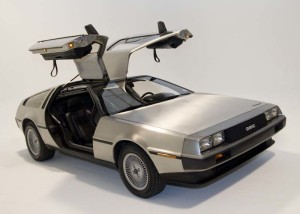
DeLorean DMC-12
We have conducted video research suggesting that a certain Dr. Emmett L. Brown, apparently out of Flux Capacitor Motors, has looked—and apparently will look again in the future—for qualified mechanics to work on his custom-modified 1981 DeLorean DMC-12. He needs/will need a high performance mechanic to diagnose why the car tops out at 88 miles per hour.
Okay, okay . . . so the video research we conducted was, in fact, us just watching a DVD of Back to the Future. We regret the error. It makes us also question the need to actually interview those famed North Carolina auto mechanics, Gomer and Goober Pyle, of Mayberry, N.C., for this piece.
Green Light
The green light to advancing your career as a high performance mechanic could begin with a strong education, but your individual skills could really take you the distance. A diploma and later ASE (Automotive Service Excellence) certifications cannot replace a natural aptitude for working on engines, building wiring harnesses, assembling drivelines and diagnosing performance problems.
The undergraduate classwork for a high performance mechanic should include these areas:
Brakes & Suspension
Diesel Fuel Systems, and Advanced Diesel Fuel Systems
Drivelines
Four Cycle Diesel Engines
Environmental Comfort Systems
Hydraulic Systems
Preventative Maintenance Inspections
Steering & Alignment
Vehicle Electrical Systems
After graduation, the high performance mechanic can take specific ASE tests:
Auto Maintenance and Light Repair Certification Test (G1)—Showing you can demonstrate knowledge of the skills necessary to handle common maintenance and light repair jobs
Advanced Engine Performance Specialist Certification Test (L1)—To prove you have the knowledge to diagnose sophisticated driveability and emissions-related problems on automobiles, SUVs, and light-duty trucks
Time Circuits and Flux Capacitor Capacitation (BTTF1)—To prove you can travel through time using a DeLorean DMC-12 when the flux capacitor is fluxing
Start Your Engine . . . Become a High Performance Mechanic
The place to start the race to a top-paying job as a high performance mechanic could be with Advanced Technology Institute’s Automotive Technology with High Performance Engineering program. The course provides you with a 75-week, four-days-a-week schedule to take your raw talent and train you for an entry-level position at automotive centers or high performance shops. Contact ATI today to learn more.
DISCLAIMER – Advanced Technology Institute (ATI) makes no claim, warranty or guarantee as to actual employability or earning potential to current, past or future students or graduates of any educational program offered. The Advanced Technology Institute website is published for informational purposes only. Every effort is made to ensure the accuracy of information contained on the AUTO.edu domain; however, no warranty of accuracy is made. No contractual rights, either expressed or implied, are created by its content.
Welcome to the Advanced Technology Institute’s Blog, your resource for industry insights and discussions on technologies shaping the future of automotive, heavy vehicle, hvac, welding, and other related career paths.
Explore how ATI’s curriculum and hands-on learning opportunities can propel your career in the tech-driven world.